Nervous System Healing
A Whole-Body Approach to Feeling Safe, Grounded and Connected
Nervous-system healing has become a popular phrase, but what does it actually mean?
It does not mean remaining calm all the time. It does not mean avoiding stress, thinking positively through every difficult experience, or performing a perfect daily wellness routine.
Our nervous system is designed to move through different states. It helps us become energized when action is needed, protective when something feels threatening, and restful when it is safe to recover.
The difficulty arises when the body becomes stuck in a pattern of ongoing alertness, shutdown, or exhaustion—and has trouble returning to balance.
In my work as a licensed acupuncture physician, Chinese medicine practitioner, yoga teacher, and specialist in fascia and somatic movement, I approach nervous-system healing through the whole body.
Rather than treating the mind and body as separate, I look at how stress may be affecting sleep, digestion, breathing, muscle tension, energy, movement, emotions, and the ability to feel present within yourself.
Healing begins by listening to what the body has been trying to communicate.
Part One
When the Nervous System Has Been Under Stress for Too Long
The nervous system continually responds to information from both inside and outside the body.
Stress may come from work, relationships, illness, pain, financial pressure, major life changes, lack of rest, or experiences that have made us feel unsafe. Even when a stressful event has ended, the body may continue responding as though the danger is still present.
This can show up in different ways.
Some people feel restless, anxious, irritable, or constantly alert. Others feel depleted, emotionally numb, unmotivated, or disconnected. Many move between the two—feeling exhausted but unable to truly rest.
Signs that the nervous system may be under prolonged strain can include:
- Feeling tired but wired
- Difficulty relaxing without distraction
- Shallow breathing or frequent sighing
- Persistent jaw, neck, shoulder, or back tension
- Trouble falling asleep or staying asleep
- Digestive changes during stressful periods
- Feeling easily overwhelmed
- Difficulty concentrating
- Emotional sensitivity or irritability
- Feeling disconnected from the body
- A sense that even small demands are too much
These responses are not evidence that your body is failing. They may be signs that it has been working hard to protect you.
Part Two
Healing Does Not Mean Forcing the Body to Calm Down
When you feel anxious or overwhelmed, being told to "just relax" is rarely helpful.
Calm cannot always be created through willpower. The body needs signals that allow it to recognize safety rather than another demand to change.
This is why nervous-system healing is usually gradual.
It may happen through repeated experiences of support: feeling the ground beneath you, receiving acupuncture, moving without pain, breathing without force, resting without guilt, or noticing a difficult sensation while still having the choice to pause.
Over time, these experiences can help build greater nervous-system flexibility.
The goal is not permanent relaxation. It is having more capacity to respond to life without becoming trapped in a prolonged state of activation or collapse.
Part Three
Acupuncture and Chinese Medicine
Chinese medicine has always viewed emotional and physical health as interconnected.
Stress may affect the movement of qi, disturb sleep, influence digestion, contribute to muscular tension, or gradually deplete the body's resources. But these patterns do not look the same in everyone.
One person under chronic stress may feel restless and overheated, while another feels cold, exhausted, and withdrawn. Someone else may primarily experience headaches, digestive discomfort, pain, or disrupted sleep.
Acupuncture treatment is therefore individualized.
By selecting points according to the person's overall pattern, acupuncture may help support relaxation, sleep, digestion, physical comfort, and a more balanced response to stress.
Many people notice that their breathing slows and their muscles begin to soften during treatment. Acupuncture creates a period in which the body receives therapeutic input without needing to perform, achieve, or figure anything out.
When appropriate, Chinese herbal medicine may provide additional individualized support, particularly when prolonged stress has affected energy, sleep, digestion, or general resilience.
Part Four
Fascia and the Physical Patterns of Stress
Stress is not experienced only as thoughts and emotions. It can also influence breathing, posture, muscle tone, and movement.
You may notice yourself lifting your shoulders, clenching your jaw, tightening your abdomen, or holding your breath. When these patterns are repeated over time, the body may begin to experience them as familiar.
Fascia—the connective tissue network that surrounds and links structures throughout the body—is part of this physical experience.
This does not mean that emotions are literally stored inside fascia. However, our emotional state can influence how we hold ourselves, how freely we breathe, and whether certain areas feel open, tense, guarded, or disconnected.
Gentle fascia-focused movement, sustained but comfortable positions, and mindful bodywork may help introduce new options.
The goal is not to force tissue to release. It is to give the body enough support, time, and appropriate sensory input to begin letting go of unnecessary effort.
Part Five
Somatic Practice: Reconnecting From Within
Somatic practices focus on experiencing the body from the inside rather than judging it from the outside.
Instead of asking, "Am I doing this correctly?" a somatic approach might ask:
- What am I feeling right now?
- Where do I sense support?
- Am I holding my breath?
- Can I make this movement smaller or easier?
- Do I want to continue, adjust, or pause?
These questions may seem simple, but they can be powerful.
Stress and difficult experiences can create a sense that we must ignore the body, override discomfort, or remain prepared for what might happen next. Somatic practice helps restore curiosity and choice.
The movements may be subtle: a gentle sway, a slow head turn, a natural stretch, or simply noticing the contact between the body and the floor.
The purpose is not to produce a dramatic emotional release. It is to build a safer and more trusting relationship with your own sensations.
Part Six
The Role of Yoga and Breath
Yoga can support nervous-system health when it is approached as a practice of awareness rather than performance.
Gentle yoga, Yin yoga, and slow intuitive movement may help reduce unnecessary muscular effort, encourage fuller breathing, and create time to notice how the body is responding.
However, not every nervous system needs complete stillness. For some people, lying quietly and focusing on the breath may initially increase anxiety. Rhythmic movement, walking, rocking, shaking, or stretching may feel more accessible.
This is why I do not believe there is one perfect nervous-system practice for everyone.
Breathing practices should also be gentle. Forcing deep breaths or following rigid breathing counts can create more tension. Sometimes it is enough to notice the breath and gradually allow the exhalation to become softer or slightly longer.
The practice should meet the body where it is—not where we think it should be.
Part Seven
My Approach to Nervous-System Healing
My approach brings together Chinese medicine, acupuncture, fascia-focused therapy, somatic awareness, and gentle movement.
These methods come from different traditions, but they share an important principle: the body is not a problem to be conquered.
I look at how different parts of a person's experience may be connected. Poor sleep, digestive discomfort, jaw tension, fatigue, emotional overwhelm, and difficulty relaxing may appear to be separate concerns, yet they can all be influenced by prolonged stress.
Rather than applying one technique to everyone, I consider what kind of support may be most appropriate at that moment.
Sometimes the body needs stillness. Sometimes it needs movement. It may need nourishment, grounding, physical release, or simply an experience in which it does not have to remain guarded.
Nervous-system healing is not about doing more. Often, it begins by creating enough space to feel, respond, and receive support.
Part Eight
Small Practices Can Create Meaningful Change
You do not need an elaborate routine to begin supporting your nervous system.
A small practice performed with attention may be more useful than a long routine that feels like another obligation.
You might begin by:
- Feeling your feet make contact with the floor
- Looking slowly around the room and noticing what feels pleasant or neutral
- Allowing your shoulders to move rather than forcing them down
- Taking a short walk without your phone
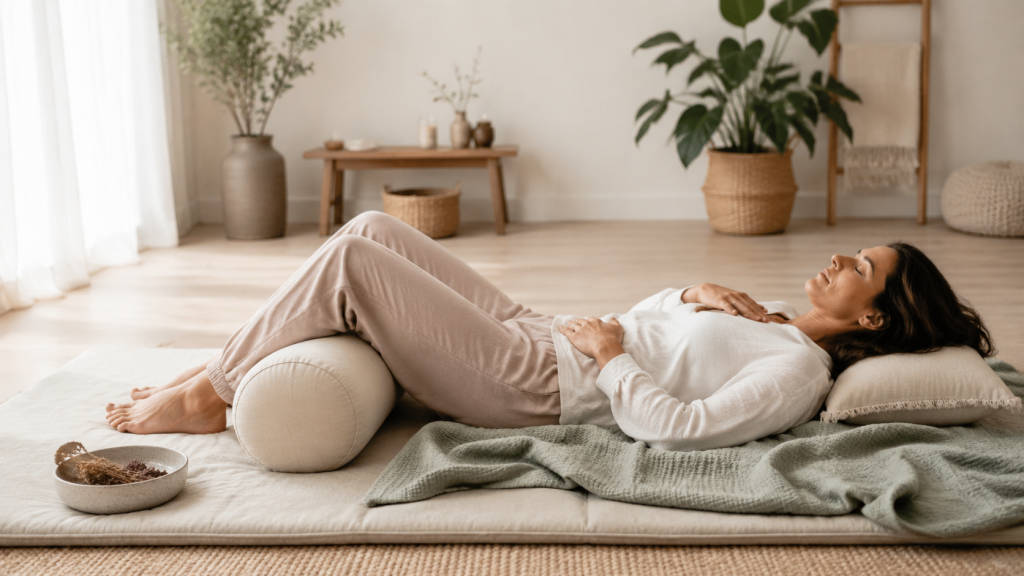
- Resting with your knees supported by a pillow
- Swaying or gently shaking out accumulated tension
- Pausing between activities instead of rushing immediately into the next one
The purpose is not to make yourself calm. It is to offer your system another experience—one with a little more support, choice, and room to breathe.
Part Nine
A Gentle Return to Yourself
Nervous-system healing is rarely a straight path.
There may be days when you feel grounded and connected, followed by days when old patterns return. This does not erase your progress. A healthier nervous system is not one that never becomes activated. It is one that has more options and a greater ability to recover.
Your body has been adapting in the best way it knows how.
Healing begins when we stop treating those adaptations as failures and start responding to them with curiosity, appropriate care, and compassion.
Through acupuncture, Chinese medicine, fascia-aware movement, yoga, and somatic practice, we can create opportunities for the body to feel supported rather than pushed.
The path is not about becoming a different person. It is about gradually finding your way back into a more connected relationship with yourself.
This article is intended for general education and wellness and is not a substitute for individualized medical or mental-health care. If you are experiencing persistent or severe symptoms, please seek support from an appropriate licensed healthcare professional.