Chinese Herbal Medicine
Ancient Wisdom, Living Tradition
On plants, patterns, and the art of individualized care
There is something deeply meaningful about working with plants.
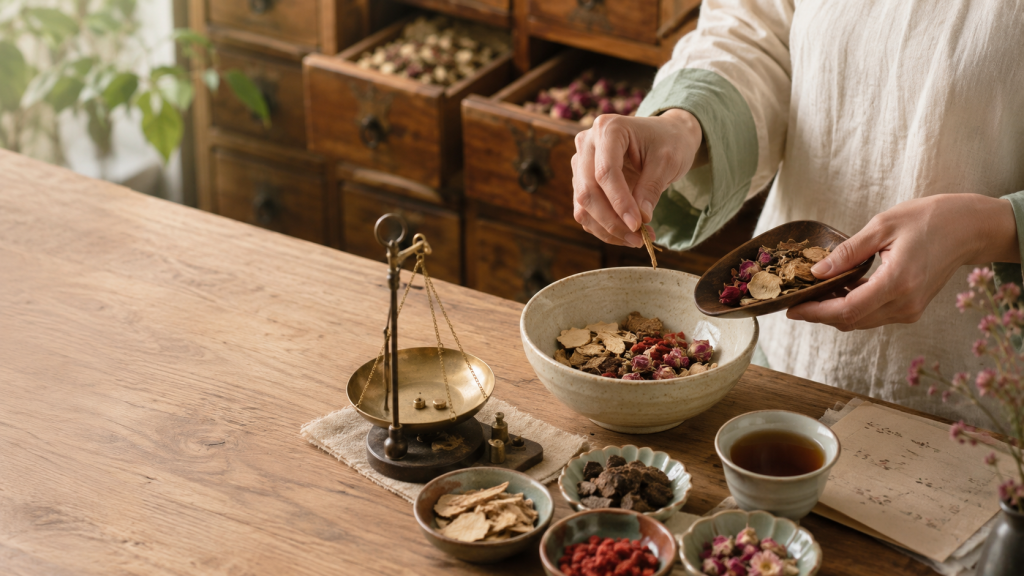
A dried root, flower, seed, leaf, or piece of bark may appear simple, yet each carries its own properties and a long history of traditional use. When carefully combined, these individual herbs become part of a formula designed to support the whole person—not merely one isolated symptom.
As a Chinese medicine practitioner and herbalist, herbal medicine is one of the parts of my work I feel especially connected to. My love of herbs began long before my formal education.
I grew up spending time on my grandparents' farm, surrounded by gardens, plants, and the understanding that nature could offer both nourishment and medicine. Both of my grandmothers worked with herbs, so using plants to care for the body never felt unusual or foreign to me. It was simply part of life.
That early connection eventually grew into a deeper study of herbalism and Chinese medicine. Today, I continue to be fascinated by the intelligence of plants and by the thoughtful, highly developed system through which Chinese herbal medicine brings them together.
Part One
A Medical Tradition Thousands of Years in the Making
Chinese herbal medicine has developed over thousands of years through observation, clinical experience, written scholarship, and the continued refinement of earlier knowledge.
Some of its foundational texts are nearly two thousand years old. These classical works recorded the properties of individual medicinal substances, explained how herbs could be combined, and described patterns that practitioners still study today.
One of the earliest herbal texts is traditionally associated with Shennong, the legendary "Divine Farmer." According to Chinese tradition, Shennong tasted numerous plants to understand their effects. While this story belongs partly to legend, it reflects an important idea: herbal knowledge developed through a close and sustained relationship with the natural world.
Later physicians organized and expanded this knowledge into increasingly sophisticated systems. They documented not only which herbs were used, but also how preparation methods, combinations, dosages, seasons, climates, and individual constitutions could influence their effects.
Chinese herbal medicine was never simply a fixed collection of ancient remedies. It became a living medical tradition—one that continued to develop as practitioners observed, questioned, and learned.
Part Two
More Than Taking a Single Herb
In Western wellness culture, herbs are often discussed individually: one herb for sleep, another for energy, and another for digestion.
Chinese herbal medicine usually works differently.
Although individual herbs may sometimes be used, treatment more often involves a carefully constructed formula. Each herb is selected for a purpose, and the ingredients are chosen according to how they work together.
Traditionally, herbs within a formula may have different roles. Some address the primary pattern, while others provide support, bring balance to the formula, or guide its overall action.
A Chinese herbal formula is not simply a collection of ingredients placed together because each one is considered healthy. It is a thoughtful combination designed to match a particular person and pattern.
This is one of the aspects of herbal medicine that I love most. Each plant has its own character, but the way the herbs interact within a formula creates something more nuanced than any single ingredient alone.
Part Three
Treating Patterns Rather Than Chasing Symptoms
Chinese medicine seeks to understand the pattern beneath a person's symptoms.
For example, several people may all experience poor sleep, but the underlying patterns may be very different. One person may feel restless and overheated at night. Another may wake frequently with racing thoughts. Someone else may sleep for many hours but still feel profoundly depleted.
Because the patterns are different, the herbal formulas may be different as well.
Rather than asking only, "Which herb is good for this symptom?" Chinese medicine asks, "What is happening within this particular person, and what kind of support does their system need?"
This individualized way of thinking is central to Chinese herbal medicine. The goal is not simply to match an herb to a symptom, but to understand how that symptom fits into the larger picture.
Part Four
The Qualities of Herbs
Chinese herbs are understood through more than their individual chemical constituents. They are also traditionally classified according to qualities such as temperature, flavor, direction, and the areas of the body they influence.
An herb may be described as warming, cooling, drying, moistening, uplifting, descending, dispersing, or nourishing.
These descriptions are part of a larger clinical language used to understand how an herb behaves in the body. They also help practitioners create balanced formulas.
A warming herb, for example, may be appropriate for someone presenting with a cold pattern but unsuitable for a person showing signs of excess heat.
In Chinese medicine, the question is rarely whether an herb is simply "good" or "bad." The more useful question is whether it is appropriate for the person, their pattern, and their needs at that moment.
Part Five
Ancient Knowledge for Modern Life
Although Chinese herbal medicine has ancient roots, it is not limited to the past.
The stresses, environments, and lifestyles of people today may look very different from those of earlier generations, but the underlying principles of individualized care remain relevant.
A formula may also be adjusted as a person's condition changes. Herbal treatment is not necessarily static. As symptoms improve or the underlying pattern shifts, the formula can evolve as well.
This ability to observe and adapt is part of what has allowed Chinese herbal medicine to remain a living tradition rather than becoming merely a historical practice.
Part Six
Why Professional Guidance Matters
The fact that an ingredient is natural does not automatically mean it is appropriate or risk-free.
Herbs can be powerful. They may interact with medications, affect certain medical conditions, or be unsuitable during pregnancy, before surgery, or in combination with other supplements. Quality, sourcing, preparation, and dosage also matter.
This is especially important in Chinese herbal medicine because formulas are intended to be selected according to an individual pattern—not chosen only because an online list associates an herb with a particular symptom.
A formula that is helpful for one person may be ineffective or inappropriate for another person with what appears to be the same concern.
Working with a qualified practitioner allows herbal medicine to be considered within the context of the whole person.
Part Seven
My Personal Connection to Herbal Medicine
Herbs bring together many of the things I value most: nature, tradition, close observation, and individualized care.
They remind me that health does not always respond to force. Sometimes the body needs nourishment. Sometimes it needs movement or warmth. At other times, it may need cooling, calming, protection, or gentle support as it rebuilds.
My background in Chinese medicine, Western herbalism, Ayurveda, yoga, and somatic practices has given me the opportunity to encounter plants through several healing traditions. Each system has its own language and philosophy, but all reflect generations of people paying close attention to the relationship between human health and the natural world.
Chinese herbal medicine continues to inspire me because of its precision. It is deeply rooted in tradition, yet it remains adaptable to the person sitting in front of me.
On a personal level, working with herbs still brings me back to the gardens and plant knowledge I encountered early in life. What began as a natural part of my childhood eventually became an important part of my professional path.
Part Eight
Herbal Medicine as Part of Whole-Person Care
Chinese herbal medicine may be used to support concerns related to digestion, sleep, stress, energy, menstrual health, seasonal wellness, and general vitality.
However, its value is not limited to addressing symptoms.
At its heart, herbal medicine invites us to look at health as a dynamic relationship. Our needs can change with the seasons, with age, during stressful periods, and as our environment or lifestyle changes.
A well-chosen formula respects that individuality.
For some people, herbs may be used on their own. For others, they may complement acupuncture, nutrition, gentle movement, or other appropriate care. The intention is not to overwhelm the body with more interventions, but to choose support thoughtfully.
Interested in Chinese Herbal Medicine?
If you are curious about whether Chinese herbal medicine may be appropriate for you, I invite you to schedule an herbal consultation.
Herbal medicine is not about finding one "miracle" plant. It is about understanding the person, respecting the plants, and bringing them together with care.
Chinese herbal medicine is a complementary healthcare practice and is not a substitute for necessary medical care. Always inform your healthcare practitioners about medications, herbs, and supplements you are taking. Do not begin an herbal formula during pregnancy, before surgery, or alongside prescription medications without appropriate professional guidance.